What we heard: Artwork and artist statement from Tiaré Lani
Visual summaries of the feedback received from the Indigenous Advisory Process
Note: This artist statement, artwork and accompanying explanations have been developed by artist Tiaré Lani. They have worked with Indigenous Services Canada (ISC) to illustrate the findings of the Indigenous Advisory Process final reports during the Collaborative Process on the Second-Generation Cut-off and Section 10 Voting Thresholds. While ISC's what we heard report provides a written summary of findings, the artwork aims to summarize the findings in a visual format.
The opinions and views set out in this work are not necessarily the opinions or views of the Government of Canada.
On this page:
About the artist
My name is Tiaré Lani. I am a 2Spiritfemme. My ancestors are from Lheidli T'enneh First Nation, Hawaii, Tahiti, China, and Ireland. I am an independent, 3rd-party artist who works in service of land back, aliveness, and for liberation in our lifetimes and for future generations.
I am a survivor of the colonial family court system, domestic patriarchal violence, sexualized violence, and systemic poverty. I learned to abandon myself to be needed, to overachieve, to meet my needs and belong. I have learned to externalize these cycles, not as flaws in me, but as survival strategies. To transform the voice that used to say, "What is wrong with me?" into "Thanks for keeping me alive long enough to make new possibilities." With support (both human and spirit), I practice welcoming myself home and know that by creating this safety within myself, I can also be an anchor to others. I thank my mother, my two-spirit ancestors, and all the connections that have supported me to grow.
I am a visual story weaver. I listen to your voices, address the truth, and make images of the future we are calling in. I offer you these images as a ritual. Ritual is the process of calling in our intentions, our spiritual supports, and our collective energy towards a vision and working together to make this a reality.
In this ritual, I invite us to weave many meanings into the images. If you see a face, a plant, a waterway, or a symbol that sparks meaning for you, then yes, this is for you. When we make stories together, we make new pathways forward.
So, I share what I heard and why I drew these images. And invite you to weave your meaning into them, too. To share them with your people. And let these images be a tool. Like my ancient Hawaiian ancestors, they looked to the stars to navigate.
Context for image creation
These images were created based on the feedback of Indigenous organizations in the Indigenous Advisory Process (IAP) to design the consultation process to remove discrimination in the Indian Act on who gets status and membership. The images reflect the key themes of what was shared by the members of the Indigenous Advisory Process.
The first image depicts the context, truth, and impacts of assimilationist tactics as well as a call for healing and reparations.
The second image reflects decolonizing consultation—key themes of how consultation must be accessible, educational, inclusive, and adequately funded, with adequate time, trauma-informed, and nourishing connection.
Image 1: Acknowledging the Colonial History and Harm Done
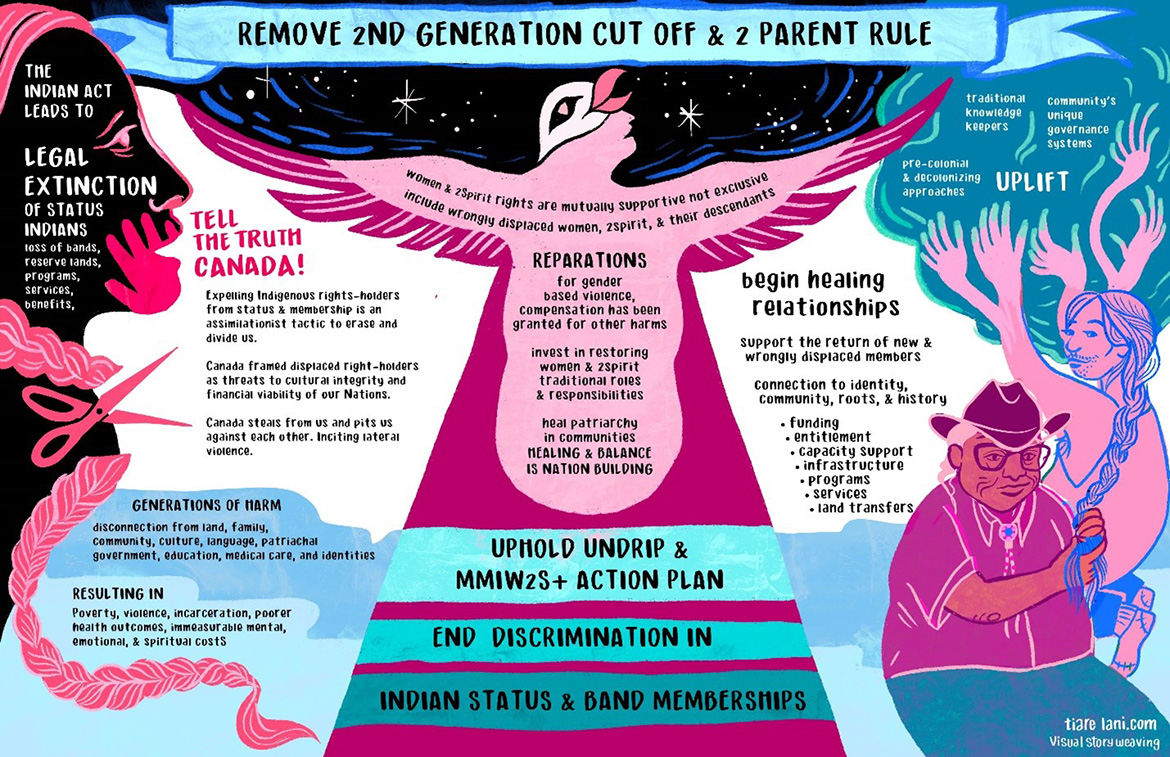
Text alternative for Image 1: Acknowledging the colonial history and harm done
Image 1 includes text, as transcribed below, from top to bottom and left to right:
Remove second generation cutoff and 2-parent rule
The Indian Act leads to:
- legal extinction of Status Indians
- loss of bands, reserve lands, programs, services, benefits
Tell the truth Canada!
- expelling Indigenous rights-holders from status and membership is an assimilationist tactic to erase and divide us
- Canada framed displaced rights-holders as threats to cultural integrity and financial viability of our Nations
- Canada steals from us and pits us against each other, inciting lateral violence
Generations of harm
- disconnect from land, family, community, culture, language
- patriarchal government, education, medical care and identities
Resulting in:
- poverty, violence, incarceration
- poorer health outcomes
- immeasurable mental, emotional and spiritual costs
Women and 2Spirit rights are mutually supportive, not exclusive
Include wrongly-displaced women, 2Spirit, and their descendants
- reparations for gender based violence, compensation has been granted for other harms
- invest in restoring women and 2Spirit traditional roles and responsibilities
- heal patriarchy in communities
- healing and balance is nation building
Uphold UNDRIP and MMIW2S+ Action Plan
End discrimination
Begin healing relationships
- support the return of new and wrongly displaced members
- connection to identity, community, rotos and history
- funding
- entitlement
- capacity support
- infrastructure
- programs
- services
- land transfers
Uplift:
- pre-colonial and decolonizing approaches
- traditional knowledge keepers
- community's unique governance systems
Our image, read from left to right, tells a story of the truth of genocide, the balance needed to restore, and the movements we make toward healing.
On the left, an Indigenous woman is silhouetted with red hand paint on her mouth to honour the MMIWG2S+ and the women, two spirits, and their descendants who were wrongly expelled from their communities. The woman's mouth is open calling Canada to acknowledge the truth of generations of harm inflicted upon our families.
The severed braid tells the story of residential school survivors having their traditional hair cut off and points to many ways colonization has attempted to sever our family connections. The colonial imposition of gender forced us into 2 categories of man and woman to create systems of dominance in our families, where before, we had diverse roles and responsibilities towards each other based on balance, harmony, and collective well-being.
These painful stories and images are held by water. Indigenous ways of recognizing that everything is living, and the spirit of water can be healing when we ask it for help and ask it to hold griefs that are bigger than our human bodies can hold. Our tears can connect us to larger bodies of water that support us to flow forward. We can thank the water. Sing songs to the water. To help us transform.
The water flows into the ribbon skirt on a woman or 2-spirit figure in the centre of the page as we call to the centre the voices of those exploited by gendered violence. The ribbon skirt is a regalia that I've witnessed my younger sibling make, and experience hope and sparkling joy in between CPTSD [complex post-traumatic stress disorder] triggers and chronic illness. When we grow up separated from wider kin networks and community to be in ceremony with, being invited to create something with pride has incredible meaning. Making regalia is a coming-of-age practice that is not about getting it right or wrong, but about finding your gifts and sharing them with the community in a way that feels good for you. It's about bravely being yourself and trusting those who are medicine for each other will find one another.
This figure becomes an eagle in the night sky. Eagles soar high above and see a wider picture and a long-term future. Eagle is compassionate to the fears scarcity has inflicted upon our communities. The fear that welcoming new members home will strain already insufficient resources. The Eagle calls on the wisdom of our ancestors, 1000's years before colonialism, to connect with one another in solidarity and claim our dignity and our birthrights. Eagle remembers that the movements of truth and reconciliation, of land back, came from survivors standing against erasure and taking up their rightful role as leaders & teachers to bring harmony and healing to a sick world.
To the far right, an Elder braids the hair of a young person. The young person's arms reach up into a tree and become the tree interlaced with the arms of other tree branches. These many arms are kin to remembering each other. Trees can offer us lessons in distributing resources and lifting each other up. Branches distribute food, so leaves and fruit flourish across the whole tree. Below the ground, networks of mycelium and roots send nutrients to hungry trees.
I chose blue and pink because they make me happy, and they are a nod to the trans flag. While we can't make assumptions about anyone's gender based on how they look, I try to draw characters that defy conventional gender presentations and hope kin on the 2SLGBTQ+ spectrum might see something of themselves or their community in the portraits.
Reflection
We call on the government of Canada to make realistic commitments.
While we breathe life into a vision of Indigenous Self-determination.
What is the vision you are breathing life into?
Look through your eagle vision to the future we want. Imagine we are healing. The truth of wrongful discrimination has been honoured, and repair efforts are ongoing and better than we could have imagined. What does this look like in your family or those you call kin? What rifts between relatives are transforming? What feast is being held, where, and with who? This might be painful, hopeful, overwhelming, exciting, stir grief, stir longing. All feelings are welcome here. It's all a part of the journey.
What scarcity myths, fears of not having enough hold us back from connection? How might your gifts flourish when you hold in loving connection and kinship? What conditions would make this possible?
Image 2: Moving forward through consultation – a decolonized approach
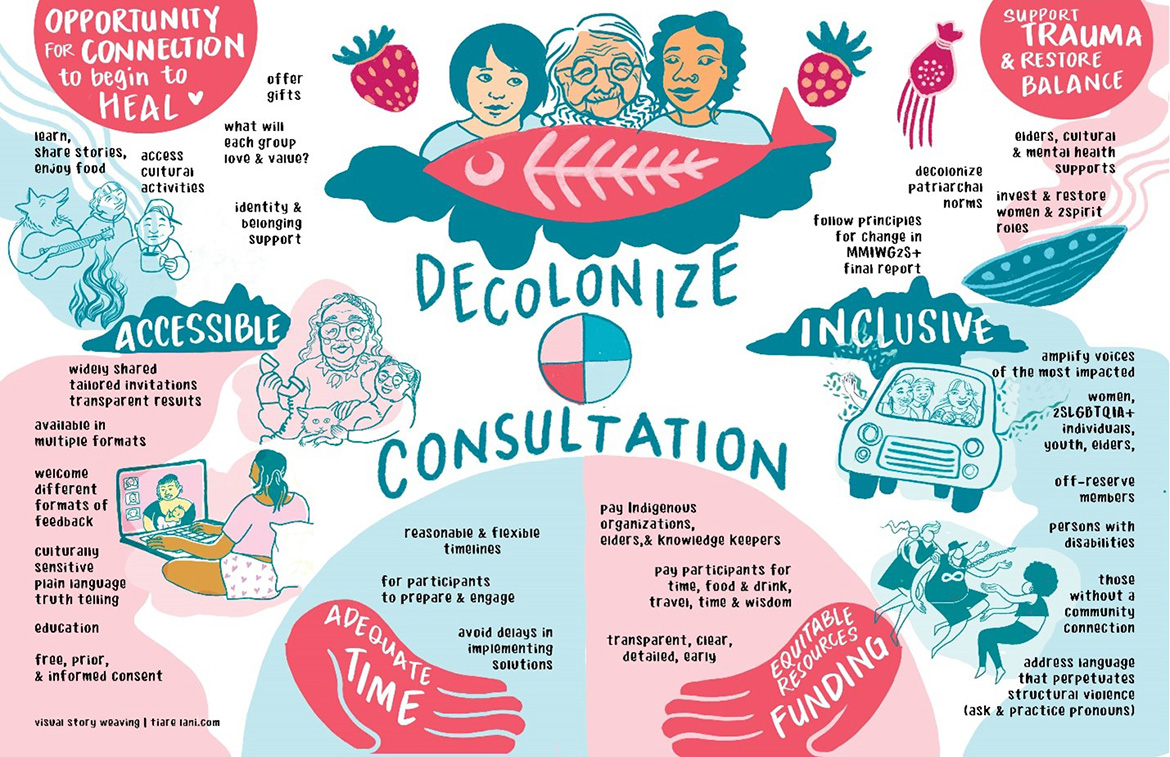
Text alternative for Image 2: Moving forward through consultation – A decolonized approach
Image 2 includes text, as transcribed below, from top to bottom and left to right:
Opportunity for connection to begin to heal
- learn, share stories, enjoy food
- access cultural activities
- offer gifts
- what will each group love and value?
- identity and belonging support
Accessible
- widely shared
- tailored invitations
- transparent results
- available in multiple formats
- welcome different formats of feedback
- culturally sensitive plain-language truth-telling
- education
- free, prior and informed consent
Decolonize consultation
Adequate time:
- reasonable and flexible timelines for participants to prepare and engage
- avoid delays in implementing solutions
Equitable resources funding:
- pay Indigenous organizations, Elders and knowledge keepers
- pay participants for time, food and drink, travel, time and wisdom
- transparent, clear, detailed, early
Support trauma and restore balance
- follow principles for change in MMIWG2S+ final report
- decolonize patriarchal norms
- Elders, cultural and mental health supports
- invest and restore women and 2spirit roles
Inclusive
- amplify voices of the most impacted
- women, 2SLGBTQIA+ individuals, youth, elders
- off-reserve members
- persons with disabilities
- those without a community connection
- address language that perpetuates structural vioence (ask and practice pronouns)
This image centres around a medicine wheel. The medicine wheel teaches us to take a holistic approach to tending to the mind, body, emotional, and spiritual well-being of communities.
At the top centre, an Elder is surrounded by her kin at a feast of salmon. How do we create a friendly, warm, nourishing experience for participants? In addition to the process leading to legal changes and additional resources, one of the most immediate gifts we can give participants is an opportunity for a well-hosted connection. The image of a wolf and youth singing around a campfire invites us to imagine what each group might love and value—and allow them to lead this.
In the "Accessible" section: an Elder holds a telephone while caring for a grandchild and her cat. Taking into consideration the technological needs of seniors. A person is cozy in their pajamas talking to a breastfeeding parent virtually.
At the bottom, hands hold the sections for: "Adequate time" and "Equitable resources / Funding" These are the foundation to make all the other parts happen!
In the "Inclusive" section: Young people in a car and relatives floating in space reflect portraits of diverse bodies who may live rurally and or without connections to their communities.
In the top right-hand corner: Trauma support includes images of traditional medicines
- an abalone shell for smudging: calling in ancestral support, clearing energy that doesn't help us move forward, and supporting us to feel grounded
- a medicine bag. This is one example of a gift offering for participants to make and take home. Or a way of accessing a traditional craft.
Across this image are portraits of people living their everyday lives. I wanted it to have a come-as-you-are, casual, everyday feeling to be inviting. I considered the question; how do we reach our relatives who are not connected to the community? I know in my own family; reconnection has come with a lot of fear and imposter syndrome. Not feeling "real." To relatives who are reconnecting, there is no right way to be native—your dignity and rights are inherent. You already belong. Your voice matters.
Reflection
Remember a gathering that you were grateful you attended. Maybe you felt like, yes, change is happening or possible. Maybe you felt like you could breathe and really bring more of your full self. Maybe the food was amazing, and the space felt welcoming. Maybe the conversation was hosted in a way that made you feel invited out. What made you glad to be there? And/or what would have made it better?