2024 Annual Report on Registration under the Indian Act, First Nations Membership and Status Cards
Table of contents
Copyright information
For information regarding reproduction rights, please contact: communicationspublications@sac-isc.gc.ca
www.canada.ca/indigenous-services-canada
TTY only 1-866-553-0554
Catalogue: R119-5E-PDF
ISSN: 2818-9469
© His Majesty the King in Right of Canada, as represented by the Minister of Indigenous Services Canada, 2025.
This publication is also available in French under the title: Rapport annuel sur l'inscription en vertu de la Loi sur les Indiens, l'appartenance aux Premières Nations et les cartes de statut – 2024
A disclaimer on the use of the term Indian
Many First Nations people in Canada prefer not to describe themselves as Indians and view this term as rooted in colonialism and racism. Under the Indian Act, the precise legal meaning of the term Indian refers to people who are entitled to registration.
Messages from Indigenous Services Canada
Message from the Deputy Minister
I am pleased to share the second Annual Report on Registration under the Indian Act, First Nations Membership and Status Cards, which highlights the important work done by Indigenous Services Canada (ISC) in 2024. This year, the Department has processed a significant number of applications, with 35,250 persons registered and 124,574 Secure Certificates of Indian Status (SCIS) issued.
For First Nations individuals, being registered under the Indian Act provides access to many essential rights and benefits that serve to honour and uphold the Government of Canada's commitments to people who are entitled to registration under the Indian Act, in the areas of health, housing, education, employment, and more. The services delivered by ISC highlight the department's efforts to deliver on its mandate and collaborate with Indigenous partners to close social and economic gaps and improve access to high-quality services. While the goal is to move beyond the Indian Act, ISC continues to provide these essential services that facilitate access to a range of services with wide-reaching benefits.
Throughout 2024, progress continued as more newly entitled individuals were registered, the SCIS Photo App provided an easier, cost-free way to complete an SCIS application, and application processing saw tangible improvements. While these advancements reflect positive momentum, ISC recognizes that more work is needed to reduce delays, address inequities, and ensure people are aware of their rights and recent changes to the Indian Act. Continued focus on outreach, system efficiencies, and policy reform will be essential to further streamline the registration process.
I invite you to read about this year's accomplishments and efforts. ISC is deeply grateful to those who helped us enhance our services, to the readers for their time and attention on the important issues outlined in this year's report, and to the Rights-Holders who continue to play a key role by providing feedback on our efforts. Your engagement and partnership are essential to achieving meaningful legislative reform. We remain committed to making the registration process timely, transparent, and accessible for all who are entitled.
Gina Wilson
Deputy Minister, Indigenous Services Canada
Message from the Registrar
Over the years, legislative amendments have resulted in a historic number of registration applications, helping individuals access a range of rights and benefits. I am optimistic that as information about changes to the Indian Act becomes more widespread and processing efficiencies continue to be introduced, both application rates and processing times will continue to improve. Although legislative amendments have helped many entitled individuals apply for registration, and addressed some lingering inequities, I acknowledge that additional work is necessary.
In response to increased registration application volumes, we launched a streamlined process to render decisions that require a more intensive analysis of entitlement on the balance of probabilities more quickly and accurately. This process is also known as the discretionary decision process. Rendering decisions efficiently and correctly is important, as decisions can impact multiple generations of descendants.
I take pride and care in my responsibility to render registration decisions based on the provisions of the Indian Act and could not achieve this work without the dedication and commitment of staff.
This valuable work is supported by Trusted Source partners across the country who assist individuals in navigating the application process and provide culturally-informed services. We appreciate the time and attention Indigenous individuals, communities and organizations take in providing feedback on the registration process.
We thank everyone who shares a continued, mutual commitment to meaningful legislative reform and to ensuring that registration is timely, reliable, and accessible for all who are entitled. We recognize the wide-ranging impacts that registration has on First Nations individuals and communities and we continue to work towards overcoming barriers, misconceptions and unnecessary delays, while upholding the integrity of the Indian Register.
Claire Thie
Indian Registrar, Indigenous Services Canada
Executive summary
This second edition of the Annual Report on Registration under the Indian Act, First Nations Membership and Status Cards covers core program operations for the 2024 calendar year. Indigenous Services Canada (ISC) provides registration, membership and status card services to First Nations persons who are entitled to be registered or are registered under the Indian Act. This year, we're also pleased to share more information about the genealogical services ISC offers individuals.
While being registered is not the sole marker of First Nation identity, registration under the Indian Act serves as a gateway to a wide-range of essential rights and benefits that serve to honour and uphold the Government of Canada's commitment to entitled individuals. ISC continues to raise awareness on changes to registration, make registration more accessible and address misconceptions about registration.
In 2024, ISC provided registration, membership, status card and genealogical services to more than 175,000 peopleFootnote 1, a new service milestone accomplished by the Department. While this report does not capture all program responsibilities, it provides valuable information related to determining entitlement to registration and membership under the Indian Act, the issuance of proof of entitlement and the important role partners have in bringing these services to individuals in a culturally-informed and community-based manner. ISC hopes that First Nations individuals, communities, organizations and anyone with an interest in registration, membership and status cards will find value in this report.
The Government of Canada has a responsibility to ensure that information about policies, programs, services and initiatives are openly communicated. To promote transparency and accountability, Canada committed to publishing an annual report on registration in the Government of Canada's response to the seventh report of the Standing Senate Committee on Indigenous Peoples titled, "Make it stop! Ending the remaining discrimination in Indian registration".
ISC appreciates the opportunity to showcase its progress towards improving service delivery and the efforts it has taken to continue eliminating inequities in registration and membership.
Operating context
Decentralized processing approach
Not all registration applications need the same amount of research and expertise. To enhance efficiency, ISC applies a decentralized approach by processing applications across the country.
Regional offices offer in-person client services, which can result in faster processing when entitlement to registration is clearly established. While other national processing units have specialized teams to focus on complex cases and understand how a person's family history may have been impacted by changing laws or other specific circumstances.
Registration and status card services are delivered through national and regional offices across Canada, and in partnership with Trusted Sources, who are critical in providing services to individuals closer to home.
Canada works together with service providers to facilitate application processing, including:
- over 700 registration administrators in 544 First Nations and Tribal Council offices
- 3 national processing units with approximately 200 processing staff
- 15 regional offices with approximately 100 staff delivering client service and processing requestsFootnote 2
- 34 Trusted Source partners
- federal, provincial and territorial government department partners
Overview of the application process
-
Step 1: Application received
- In person at a regional office, First Nations office or Trusted Source
- By mail
-
Step 2: Application assessed
- Confirm an individual's identity
- Assess application completeness
- Send to the appropriate national processing unit, if necessary
-
Step 3: Entitlement determined
- Review all documents submitted and available information within departmental records
- Seek more information from the applicant and/or provincial or territorial authorities, if necessary
- Take into account multi-generational life events to apply the registration provisions of the Indian Act
- Applicable quality assurance process to ensure accurate decision-makingFootnote 3
-
Step 4: Registration decision communicated
- Letter sent to communicate the decision to the applicant and affiliated band administrator
- Secure Certificate of Indian Status (SCIS) is issued, if requested
In some cases
-
Protest: Investigation conducted
- Individual, band council or any member submits a protest in writing within 3 years of the initial registration entitlement decision
- ISC conducts an investigation and the Registrar issues a decision
- Letter is sent to communicate the decision to the protestor and/or protestee
-
Appeals: Decision appealed to the courts
- Individual, band council or any member submits an appeal to the courts within 6 months of the protest decision
- Court issues a decision or refers the case back to the Registrar for reconsideration or further investigation
Factors impacting application processing
Settlements
In 2024, ISC continued to support the settlement process by making registration decisions and providing individual or collective data from the registration system.
There are several ongoing settlements to compensate Indigenous individuals and communities to address historical injustices, honor treaty rights and support reconciliation, which may also contribute to difficulties in predicting application volumes. Settlements often lead to increased demands for priority processing, as registration may impact a person's ability to participate in settlement related activities. As such, ISC must continue to adapt its processes to remain responsive to changing volumes and urgent registration requests driven by settlement-related timelines.
Some examples of recent settlements include the recent Ontario v. Restoule settlements, as well as agricultural benefits settlements, land-related settlements, drinking water settlements, and settlements related to child and family service administration.
Canada Post Strike
On November 15, 2024, a nationwide Canada Post strike began and ended when workers returned to work on December 17, 2024. During this time, the total volume of applications received during the strike was reduced.
ISC was able to use courier services to continue to deliver priority items to all regions in Canada. Priority items were considered on a case-by-case basis and included Temporary Confirmation of Registration Documents and any original documents held by ISC, such as proof of birth documents.
Applications received prior to the strike were processed as usual while new applications and other documents were still able to be submitted by courier service, or in-person at any regional office, or a First Nation or trusted source office, if they offered registration services and/or SCIS services.
Both during and after the strike, ISC made a deliberate effort to minimize the impact of the strike on application processing. ISC continued to process the inventory of applications it had on hand. Any updates about the strike were communicated publicly on ISC's website and social media pages. ISC also encouraged regional offices to communicate strike updates to First Nations and trusted sources.
Access to identification in emergency situations
ISC and First Nations offices regularly provide support in emergency situations through emergency management service agreements with provinces, territories and Trusted Sources. One of the key roles that ISC plays in emergency response situations is to support First Nations communities by issuing status cards and Temporary Confirmation of Registration Documents to individuals experiencing wildfires, floods or evacuations. In 2024, the frequency and severity of emergency situations increased the demand of these services.
Registration in numbers
Registered persons in Canada

Text alternative for Registered persons in Canada
- Total registered persons in Canada as of December 31, 2024: 1,116,323
- Registered population by gender:
- Male: 549,283
- Female: 566,679
- Another Gender: 361
- Registered population by province and territory (highest to lowest population):
- Ontario: 242,985 or 22%
- Saskatchewan: 181,504 or 16%
- Manitoba: 178,595 or 16%
- British Columbia: 161,241 or 14%
- Alberta: 143,241 or 13%
- Quebec: 106,259 or 10%
- Atlantic: 71,760 or 6%
- Northwest Territories: 20,660 or 2%
- Yukon: 10,078 or 1%
Population statistics for each First Nation, based on the data in the Indian Register, are available on the First Nation Profiles.
Registration does not confirm whether a person is Indigenous, but rather, whether that person is entitled to be registered under the Indian Act. That means the identity of individuals, such as non-registered First Nations, Inuit and Métis, all of whom are Indigenous, cannot be confirmed by the Indian Act.
For a more fulsome overview of Indigenous populations in Canada, Statistics Canada provides Statistics on Indigenous Peoples regarding persons who self-identify as Indigenous on a range of topics.
Registration Service Standards and Processing Times
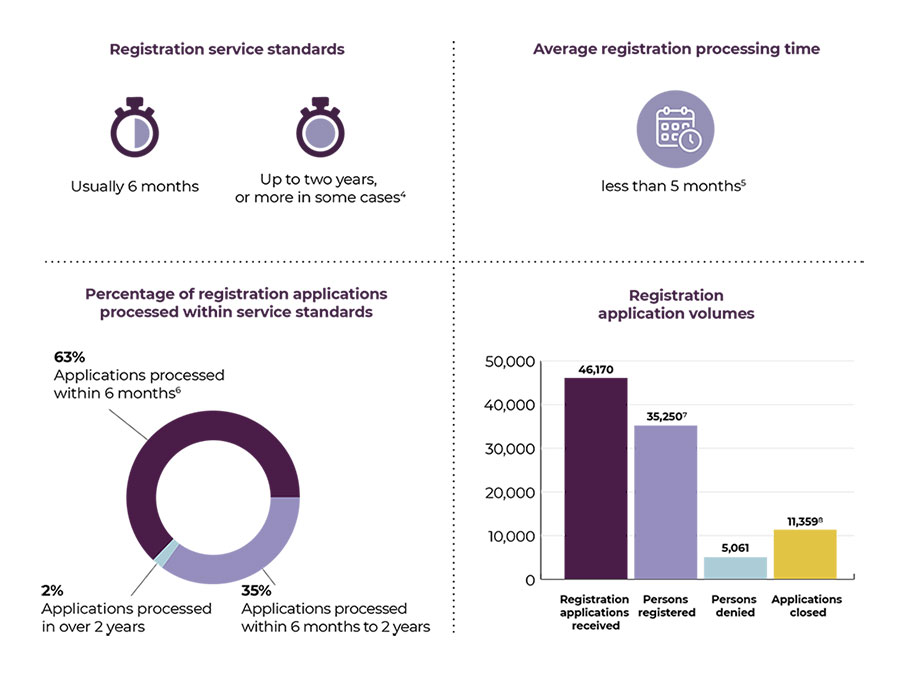
Text alternative for Registration service standards
This infographic depicts key information and statistics related to registration applications for the 2024 calendar year.
- Registration service standards
- Usually 6 months
- Up to two years, or more in some casesFootnote 4
- Average registration processing time: less than 5 monthsFootnote 5
- Percentage of registration applications processed within service standards
- 63% of applications processed within 6 monthsFootnote 6
- 35% of applications processed within 6 months to 2 years
- 2% of applications processed in over 2 years
- Registration application volumes
- Registration applications received: 46,170
- Persons registered: 35,250Footnote 7
- Persons denied: 5,061
- Applications closed: 11,359Footnote 8
Increased registration volumes
The annual number of applications receivedFootnote 9 has increased from 40,950 in 2023 to 46,170 in 2024, showing greater awareness of and access to registration.
While ISC is committed to lowering processing times, some applications may require extensive research to maintain the integrity of the Indian Register. As part of the registration process, ISC may require further information from applicants. In 2024, ISC sent 9,194 follow-up letters to applicants requesting more information to facilitate application processing. Although timely registration is critically important, ISC emphasizes that the accuracy of decision-making cannot be compromised for service standards and that both must be valued.
ISC will continue efforts year over year to process more applications than received as part of the Department's commitment to reducing the inventory of applications received in previous years and achieving shorter processing times for individuals. ISC's target is to render 70% of registration decisions delivered within the 6-month service standard.
Registration volumes: 2016-2024

Text alternative for Registration volumes: 2016-2024
The chart shows the number of registration applications received and decisions rendered on those applications from 2016 to 2024.
| Year | Registration applications received | Applicants registered | Applications denied | Applications closed |
|---|---|---|---|---|
| 2016 | 26,507 | 21,704 | 5,274 | 6,142 |
| 2017 | 26,482 | 21,881 | 2,413 | 5,161 |
| 2018 | 26,249 | 15,906 | 9,647 | 2,847 |
| 2019 | 28,339 | 19,069 | 3,425 | 3,315 |
| 2020 | 19,236 | 17,581 | 1,786 | 3,899 |
| 2021 | 26,823 | 26,292 | 6,477 | 11,425 |
| 2022 | 33,405 | 30,136 | 5,470 | 5,269 |
| 2023 | 40,950 | 32,784 | 4,364 | 4,114 |
| 2024 | 46,170 | 35,250 | 5,755 | 11,359 |
Secure Certificate of Indian Status in numbers

Text alternative for Secure Certificate of Indian Status in numbers
This infographic depicts key information and statistics related to the Secure Certificate of Indian Status (SCIS) (also known as the secure status card) applications for 2024Footnote 10.
- SCIS service standards: 8 – 12 weeks
- SCIS application processing times: Average of 10.3 weeks
- SCIS application volumes
- SCIS applications received: 118,736
- SCIS applications processed: 129,710Footnote 11
- SCIS issued: 124,574
Types of status card issued
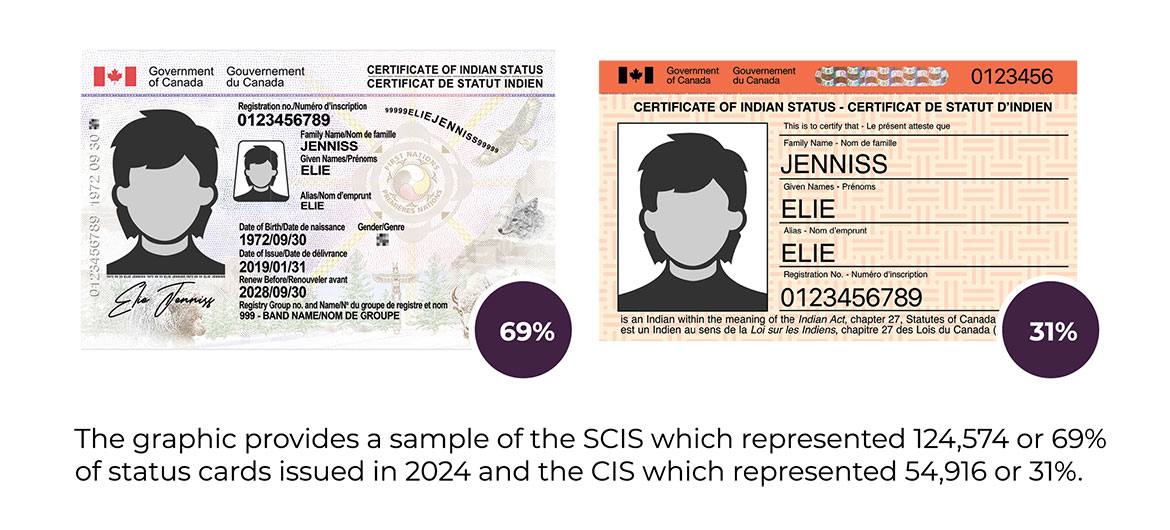
Text alternative for Type of status card issued
The graphic provides a sample of the SCIS which represented 124,574 or 69% of status cards issued in 2024 and the Certificate of Indian Status (CIS) (also known as the paper laminated status card) which represented 54,916 or 31%.
Active cardholders
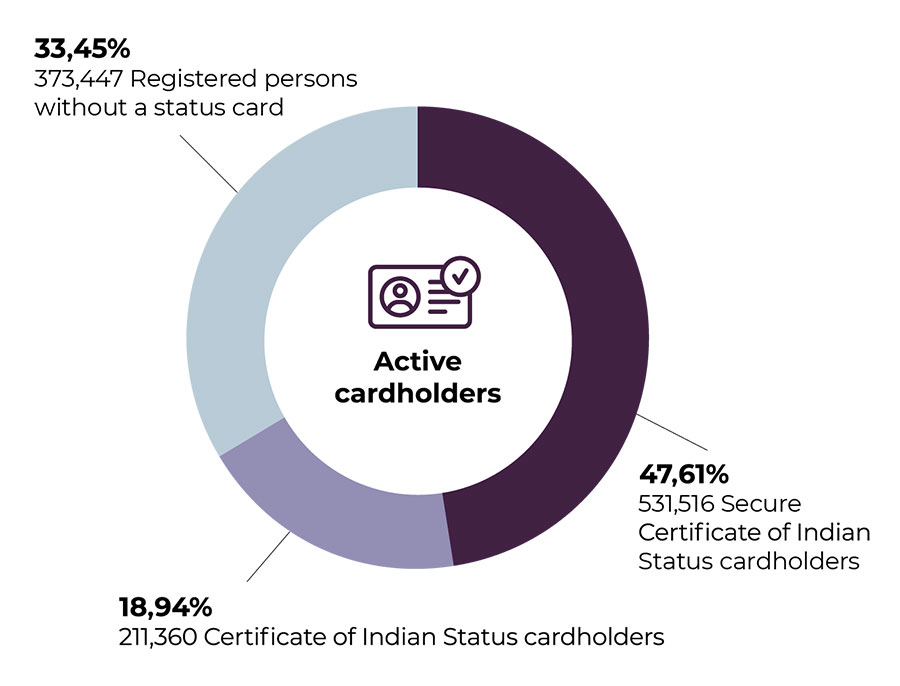
Text alternative for Active cardholders
- 211,360 (18,94%) Certificate of Indian Status cardholders (CIS)
- 531,516 (47,61%) Secure Certificate of Indian Status cardholders (SCIS)
- 373,447 (33,45%) Registered persons without a status card
This chart shows the number of active SCIS and CIS cardholders, as well as the number of registered persons without a status card.
Increased Secure Certificate of Indian Status volumes
ISC has made a wide range of efforts over the past several years to make registration and the SCIS more accessible to individuals and to streamline the application process. Since the introduction of the SCIS in 2009, there has been a significant increase in applications received.
In 2024, ISC received the highest number of SCIS applications yet, representing more than 11% of the registered population in a single year. The Department issued 124,574 SCIS with more than a 96% application success rate. Because the SCIS is issued after a person is registered, delays in card issuance are oftentimes from individuals waiting to be registered, or from individuals who submitted an incomplete application. Since registration volumes have increased, the volume of SCIS issued have increased as well. ISC does not charge individuals for the issuance of the SCIS, which facilitates access to programs and services.
Secure Certificate of Indian Status volumes: 2010-2024

Text alternative for Secure Certificate of Indian Status volumes: 2010-2024
This graph shows the total number of SCIS cards issued from 2010 to 2024.
| Year | Total Number of SCIS Issued |
|---|---|
| 2010 | 9,792 |
| 2011 | 6,089 |
| 2012 | 53,304 |
| 2013 | 44,231 |
| 2014 | 34,948 |
| 2015 | 33,623 |
| 2016 | 34,178 |
| 2017 | 35,213 |
| 2018 | 44,303 |
| 2019 | 54,316 |
| 2020 | 36,513 |
| 2021 | 44,833 |
| 2022 | 72,018 |
| 2023 | 102,014 |
| 2024 | 124,574 |
Part of the increase in volume in SCIS issuance to registered persons year over year can be attributed to the new Digital Application Services tool, available for in-person applications at regional offices, reduced processing times and more Trusted Source locations. The new digital tool represents a significant move beyond the traditional paper-based and mail-in application process allowing for an easier application process. The Digital Application Services is currently available at ISC's regional offices and we plan to make it available to Registration Administrators and Trusted Source partners in the near future.
Protest in numbers
A protest is a formal request to the Registrar to contest the decisions concerning registration in the Indian Register and departmentally maintained band lists in the Indian Register under section 14.2 of the Indian Act. ISC supports the rights of individuals and First Nations in protesting the addition, omission or deletion of individuals from the Indian Register or departmentally maintained membership within 3 years of the registration decision. Individuals may also protest their registration category in the Indian Register. For example, if an individual is registered under sub-section 6(2) of the Indian Act, but believe they should be registered under paragraph 6(1)Footnote 12.
Should the protestor(s) disagree with the final decision, they have six months to submit an appeal to a provincial/territorial court of appeal.

Text alternative for Protest in numbers
- Protests and appeals volume:
- Notices of protest assessed for validity: 449Footnote 13
- Notice of protests received: 228Footnote 14
- Protest decisions rendered: 14
- Decisions appealed to the courts: 0
Genealogy in numbers
The Genealogy and Archival Research (GAR) unit at Indigenous Services Canada is responsible for helping Indigenous individuals research their First Nations ancestry.
To ensure efficient, responsive, and personalized support, the unit offers the following services:
- Letters of ancestry: issues a formal letter to registered First Nations individuals documenting their ancestry based on departmental historical records, typically for individuals seeking to establish their eligibility to live, work or study in the U.S.
- Family history searches: conducts family history searches using the Indian Register for both registered and non-registered First Nations individuals seeking to trace their family history, which may include information on ancestors such as the names, dates of birth/marriage/death, registration numbers, registration dates, and First Nation affiliation, when availableFootnote 15.
- Research support for other departmental units: provides support to other units involved with the registration process for individuals or families seeking recognition under the Indian Act, through support with internal and external historical, archival and genealogical research.
- Historical archive management: manages the collection, organization, and preservation of historical records related to registration, ensuring that records are accessible and maintained for future use.
Genealogy and archival research in numbers

Text alternative for Genealogy and archival research in numbers
- 1,514 family history searches
- 553 letters of ancestry
First Nations' Governance in numbers
The Indian Register is the official record for people registered under section 6 of the Indian Act and membership lists maintained under section 11 of the Indian Act. Each person has a record in the Indian Register that lists their personal information, for example, name, date of birth, registration number, First Nation affiliation and ancestry. When an individual is registered, they are affiliated to a First Nation in the Indian Register. Affiliation in the Indian Register may not always result in membership, as it depends on whether the First Nation's membership list is maintained by ISC or the First Nation. More information can be found in First Nation Profiles.
If the First Nation's membership list is maintained by ISC under section 11 of the Indian Act, affiliated persons automatically become a member of that First Nation.
If the First Nation maintains its own membership list under section 10 of the Indian Act or a self-government agreement, affiliated persons do not automatically become a member of that First Nation. To become a member, affiliated persons need to apply to the First Nation as the First Nation determines who is a member based on their own membership rules. Some First Nations may use other terms, such as citizenship, instead of membership.
First Nations by control of membershipFootnote 16

Text alternative for First Nations by control of membership
This chart shows the breakdown of First Nations by control of membership in 2024.
- First Nations recognized by ISC/CIRNAC in Canada: 619
- Membership lists maintained by ISC under section 11: 350
- Membership lists maintained by First Nation under section 10: 229
- Membership lists maintained through self-government agreements: 40
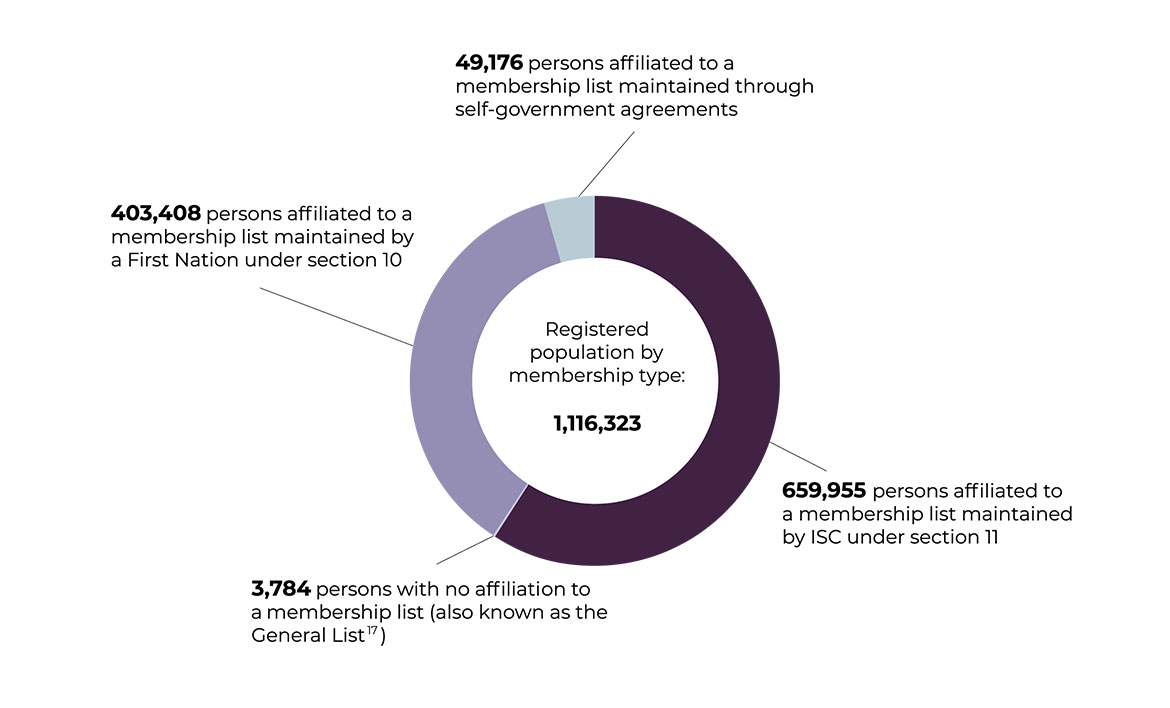
Text alternative for Registered population by membership type
This chart shows the breakdown of the registered population by membership type in 2024.
- Registered population by membership type as of December 31, 2024: 1,116,323 registered persons in total
- 659,955 persons affiliated to a membership list maintained by ISC under section 11
- 403,408 persons affiliated to a membership list maintained by a First Nation under section 10
- 49,176 persons affiliated to a membership list maintained through self-government agreements
- 3,784 persons with no affiliation to a membership list (also known as the General ListFootnote 17)
Reporting limitations
Processing times are based on the date the application is received by ISC. An individual may be given 90 to 120 days to provide additional information to support their application, while maintaining their place in the processing queue to prevent further delays.
ISC is currently evaluating its decentralized processing approach, which impacts the ability to provide precise and accurate processing times for all applications. In the current state, processing times may vary depending on where and how the application was submitted and the genealogical research required for the application. Future annual reports will aim to provide improved data on application processing times.
The Office of the Auditor General of Canada undertook an audit of registration between April 1, 2019 to March 31, 2024, and published the findings in June 2025, which may cause some variance in data due to the differences between the 5-year timeframe of the audit and the annual timeframe of this report. ISC welcomes this audit and the opportunity to continue to make substantive reforms to both the law governing registration and membership, as well as the process that supports it.
ISC only collects data necessary to meet its obligations under the Indian Act and to support the provision of rights and benefits to entitled and registered individuals. There are no immediate plans to expand data collection for research purposes.
Reforming registration under the Indian Act
Bill S-2 (formerly Bill C-38)
In March 2022, the Minister of Indigenous Services confirmed the Government of Canada's commitment to follow through on the findings of prior national consultations, such as the 2018 Collaborative Process on Indian Registration, Band Membership and First Nation CitizenshipFootnote 18, and to address enfranchisement-related inequities in the Indian Act in a timely manner.
Bill C-38, An Act to amend the Indian Act (new registration entitlements), was first introduced in the House of Commons in December 2022, but did not pass before Parliament was dissolved in March 2025. Bill C-38 was then reintroduced in the Senate of Canada on May 29, 2025 as Bill S-2Footnote 19.
Bill S-2 seeks to address some of the remaining inequities in registration under the Indian Act to:
- ensure persons with a family history of enfranchisement will be treated the same as those without;
- support persons who wish to have their names removed from the Indian Register to apply for deregistration;
- support women who were automatically transferred to their husbands' First Nation and their descendants to seek reaffiliation with their natal First Nation; and
- remove outdated and offensive language related to dependent persons.
To make sure applications are processed efficiently for persons with a family history of enfranchisement who would be denied under the Indian Act today, the department has placed their applications on hold until Bill S-2 becomes law or more information can be provided.
Collaborative process on the second-generation cut-off and section 10 voting thresholds
On November 20, 2023, ISC launched the Collaborative Process on the Second-Generation Cut-off and Section 10 Voting Thresholds, a consultation process seeking First Nations-led legislative solutions to these issues.
Second-generation cut-off
Bill C-31 created two different registration categories under subsubsections 6(1) and 6(2) of the Indian Act. Persons entitled under 6(1) can pass down entitlement on their own, while persons entitled under 6(2) can only pass down entitlement to their descendants if they parent with another entitled person. In other words, entitlement is cut-off after the second-generation of parenting with a non-entitled person.
Registered persons by 6(1) and 6(2) category codes

Text alternative for Registered persons by 6(1) and 6(2) category codes
This chart shows the total registered population as of December 31, 2024: 1,116,323
- 327,370 Persons registered 6(2)
- 788,953 Persons registered 6(1)
During the 2018-2019 Collaborative Process on Indian Registration, Band Membership, and First Nation Citizenship, the Minister's Special Representative Claudette Dumont-Smith reported that a separate and more in-depth consultation is required to determine how best to address the second-generation cut-off. This ongoing collaborative process was not introduced to consider whether to address the second-generation cut-off, but rather how to remedy the issue.
Section 10 voting thresholds
Bill C-31 ensures First Nations have the ability to take control of their membership under section 10 of the Indian Act with the consent of their electors. The intent to take control must be approved by a majority of the majority (double majority) of the electorsFootnote 20. In other words, a majority of the eligible electors must vote, and a majority of those who vote must be in favor of the change. Since 1987, nearly 70 First Nations have initiated the process, but many have been unable to meet this threshold due to challenges reaching electors.
The Collaborative Process on the Second-Generation Cut-off and Section 10 Voting Thresholds consists of two key phases:
- Phase 1: Co-development and Information-sharing
- Indigenous Advisory Process: ISC partnered with 17 Indigenous organizations to seek guidance and co-develop consultation materials. ISC received 12 final reports from the Indigenous Advisory Process that outlined their findings and recommendations.
- Indigenous inspired artwork: Indigenous graphic recorder Tiaré Lani was commissioned by ISC to create artwork reflecting the feedback and insights from the Indigenous Advisory Process.
- What We Heard Report: Published by ISC, this report highlights the feedback and insights collected from the 12 final reports following the Indigenous Advisory Process.
- Rights-holders information kit: Published by ISC, this report provides a detailed explanation of the issues for consultation. Beginning in February 2024, the Kits were broadly distributed to First Nations, Tribal Councils, Treaty Organizations, and representative Indigenous organizations across Canada.
- Community-specific data sheets: Distributed by ISC alongside the Rights-Holders Information Kit, and highlights how the second-generation cut-off impacts each First Nation community's registered population.
- Information sessions: ISC offered both virtual and in-person sessions to First Nation individuals and communities, Tribal Councils, administrators, Indigenous Groups, organizations, and the general public, to describe the issues for consultation and ensure participants could pose questions about and receive insights into the Collaborative Process. In 2024, ISC held 44 sessions to approximately 900 participants with information sessions ongoing throughout the Collaborative Process.
- Phase 2: Consultation events and activities
- Co-developed Consultation Plan with the Indigenous Advisory Process: Outlined the shared objectives, legal rationales for consultation, lessons learned from previous consultation processes, the consultation methods for the Collaborative Process, funding opportunities, and timelines.
- Call for Proposals – First Nation-led Options for Solutions: Launched in December 2024 to provide funding opportunities for First Nations, Tribal Councils, and representative Indigenous organizations for engagement and research activities resulting in a report of proposed solutions. Over 90 First Nations and Representative Organizations submitted a funding application.
Engagement and outreach
In an effort to ensure that information-sharing reached First Nations, Indigenous Rights-Holders and organizations and impacted individuals across Canada, Indigenous Services Canada:
- Shared approximately 30 social media posts across Facebook, LinkedIn, and X (Twitter) about the Collaborative Process on the Second-Generation Cut-off and Section 10 Voting Thresholds.
- Partnered with Indigenous Link, a third-party Indigenous organization. During the first two weeks of the launch, they had over 1,000 visitors on their landing page and emails were distributed to over 21,000 subscribers, including First Nation rights-holders, communities and leaders, with information on the Collaborative Process on the Second-Generation Cut-off and Section 10 Voting Thresholds.
- Indigenous Services Canada's webpages related to the ongoing Collaborative Process on the Second-Generation Cut-off and Section 10 Voting Thresholds had a total of 34,338 website views (monthly average of 2,862) throughout 2024.
Rightsholder kit and distribution
A Rights-Holders Information Kit was created to support First Nations involvement in a consultation process on the Collaborative Process on the Second-Generation Cut-off and Section 10 Voting Thresholds. It provided background information on the two issues being consulted on and a historical and present overview of registration under the Indian Act. It was distributed to every First Nation in Canada.
Implementation of the United Nations Declaration on the Rights of Indigenous Peoples Act (UNDA)
Registration has deeply-rooted personal and powerful consequences on First Nations individuals and communities, demonstrated by the diverse range of perspectives on key issues related to registration. Any changes to the registration provisions of the Indian Act should be based on the perspectives of Indigenous Rights-Holders and the principles of the United Nations Declaration on the Rights of Indigenous Peoples Act (UNDA).
Canada's UNDA action plan includes three interconnected measures on civil and political rights that focus on removing remaining inequities in the registration and membership provisions of the Indian Act or moving away from Indian Act registration and membership provisions toward citizenship.
- Measure 2.7: Support the adoption of Bill S-2, which seeks to address discrimination in the registration and membership provisions of the Indian Act
- Measure 2.8: Co-develop a collaborative consultation process on a suite of broader reforms relating to registration and band membership issues, prior to any transition away from the Indian Act. Seek to make the Act's registration and band membership provisions more consistent with the declaration, until a clear consensus on a way forward on comprehensive change or the Act's repeal is possible
- Measure 2.9: Consult First Nations and other impacted Indigenous groups to support the co-development of opt-in alternatives to Indian Act registration and membership (First Nation citizenship)
The goal of the Collaborative Process on the Second-Generation Cut-off and Section 10 Voting Thresholds is to support the Government of Canada's commitment to First Nations and the UNDA action plan. While Indian Act registration provisions require further reform, the significance of recognizing individual's rights under the Indian Act should not be undervalued.
Convention on the Elimination of All Forms of Discrimination Against Women (CEDAW)
On October 16, 2024, the Convention on the Elimination of All Forms of Discrimination Against Women (CEDAW) Committee held its 10th review of Canada's compliance with the Convention on the Elimination of All Forms of Discrimination Against Women in Geneva. Despite amendments made to the Indian Act, the Committee shared deep concerns about the ongoing gender-based discrimination against Indigenous women and girls in Canada.
The Committee recommended that Canada overhaul the Indian Act to remove the discrimination against women and their descendants. This includes the elimination of the second-generation cut-off. The Committee recommended that:
- section 6 of the Indian Act must be amended to remove categories 6(1)(f) and 6(2)
- any other legal provisions that do not recognize the equal right of men and women to hold and transmit entitlement be removed
- Canada must eliminate all remaining categories or classes of entitlement to registration, including differentiations in entitlement caused by birth and marriage dates before and after April 17, 1985
Through the ongoing Collaborative Process on the Second-Generation Cut-off and Section 10 Voting Thresholds Canada hopes to address the concerns of the Convention on the Elimination of All Forms of Discrimination Against Women, while respecting the Government's duty to consult and advocating for First Nation led solutions to the issues.
Service improvement initiatives
Service delivery
ISC is dedicated to improving service delivery by implementing innovative solutions and fostering collaboration with Indigenous communities. The ongoing initiatives below will not only reduce processing times and simplify the application process, but also ensure clients receive timely and culturally responsive support.
Trusted Sources
A Trusted Source can help individuals complete an application for registration and a status card.
A Trusted Source is a Registration Administrator from a First Nation office or from an Indigenous organization, who serve as additional points of service across the country to expand access to registration and status card services beyond ISC regional offices, including for persons residing off-reserve, and support wider efforts to transfer service delivery to Indigenous peoples in a culturally-sensitive manner.
Trusted Sources for registration and status card applications
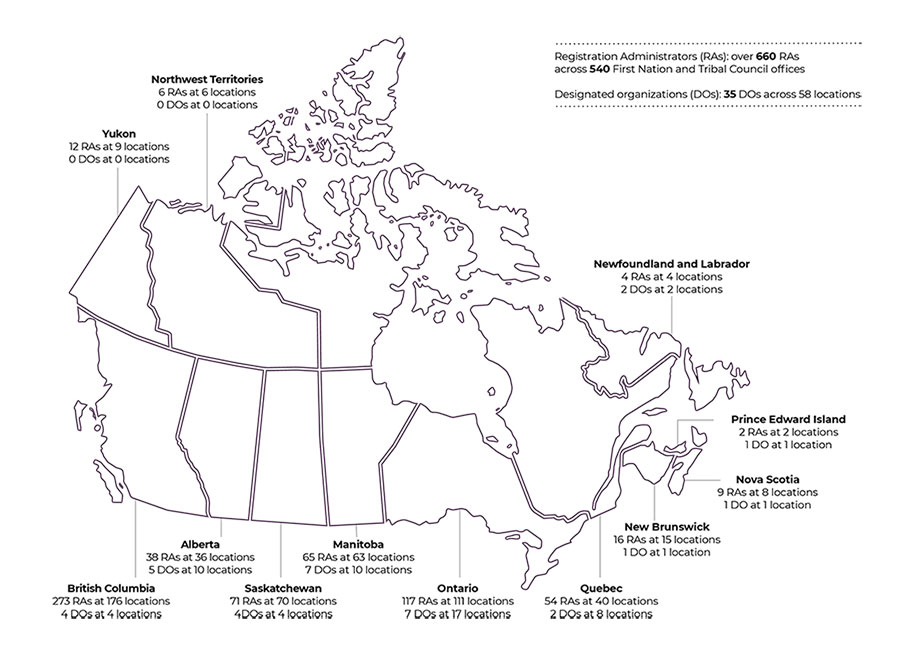
Text alternative for Trusted Sources for registration and status card applications
This graphic provides a map of Trusted Source locations. Additionally, 544 First Nation and Tribal Council offices offer registration and/or status card services across Canada, which are not indicated on the map. For a list of trusted sources organizations, visit Designated Trusted sources for registration and secure status card applications.
There are Trusted Sources across Canada offering registration and/or status card services, including:
-
Registration Administrators (RAs): over 660 RAs across 540 First Nation and Tribal Council offices
- P.E.I.: 2 RAs at 2 locations
- New Brunswick: 16 RAs at 15 locations
- Nova Scotia: 9 RAs at 8 locations
- Newfoundland: 4 RAs at 4 locations
- Quebec: 54 RAs at 40 locations
- Ontario: 117 RAs at 111 locations
- Manitoba: 65 RAs at 63 locations
- Saskatchewan: 71 RAs at 70 locations
- Alberta: 38 RAs at 36 locations
- British Columbia: 273 RAs at 176 locations
- Yukon: 12 RAs at 9 locations
- Northwest Territories: 6 RAs at 6 locations
-
Designated organizations (DOs): 34
- P.E.I.: 1 DO at 1 location
- New Brunswick: 1 DO at 1 location
- Nova Scotia: 1 DO at 1 location
- Newfoundland: 2 DOs at 2 locations
- Quebec: 2 DOs at 8 locations
- Ontario: 7 DOs at 17 locations
- Manitoba: 7 DOs at 10 locations
- Saskatchewan: 4 DOs at 4 locations
- Alberta: 5 DOs at 10 locations
- British Columbia: 4 DOs at 4 locations
- Yukon: 0 DOs at 0 locations
- Northwest Territories: 0 DOs at 0 locations
Registration administrators
Registration Administrators in First Nations communities, also known as membership clerks, are people selected by First Nations to assist with registration, membership and status cards in a culturally-informed manner specific to their community.
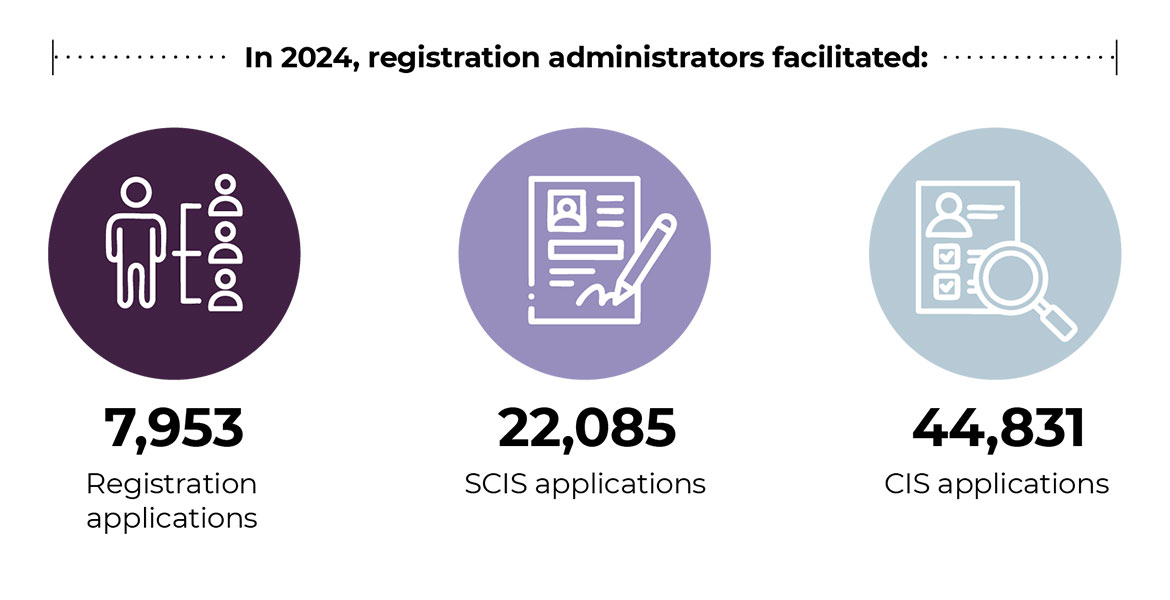
Text alternative for Registration administrators
In 2024, registration administrators facilitated 7,953 registration, 22,085 SCIS and 44,831 CIS applications.
Registration Administrators are compensated by ISC through contribution funding. The formula provides $7.07 per capita, and $15.00 per transaction with a minimum of $5,000 per year per First Nation. In 2024, First Nations received $11.6M in grants and contributions funding. More information is available in Annex A: Financial and human resource statements Funding Table.
Their support has been improved through online training to expand and strengthen community-level and community-led service provisions:
- Training is provided on an ongoing basis to account for new Registration Administrators or to improve existing knowledge
- The number of training participants decreased from 311 in 2023 to 253 in 2024 because of the retention of qualified Registration Administrators in First Nation offices
- A total of 195 Registration Administrators have been certified to examine original proof of birth documents for registration applications to ensure authenticity and better assist applicants who no longer need to mail in their original document
Designated organizations
Additional Trusted Source partners can be designated Indigenous organizations, who also support individuals in the application process. These organizations help to fill service gaps and expand points of service in urban and other areas across Canada at various Indigenous-run organizations, such as a Friendship Centre. A list of designated organizations and their locations are available on Find a trusted source to help you register under the Indian Act or apply for a secure status card.
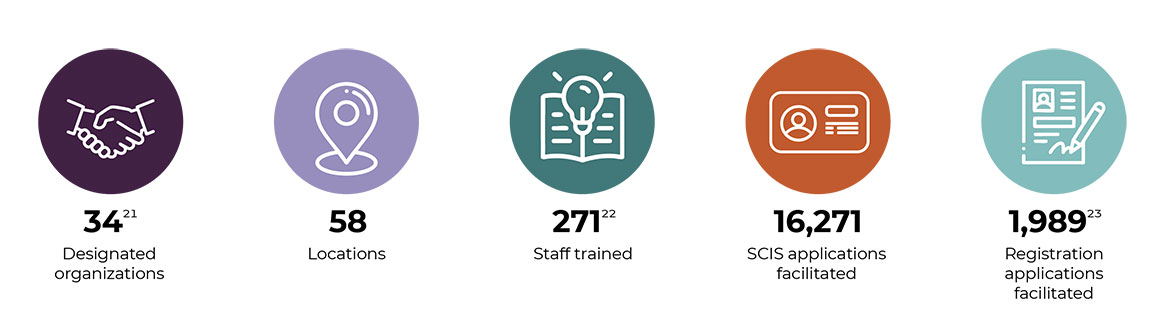
Text alternative for Designated organizations
| Designated organizations | Locations | Staff trained | SCIS applications facilitated | Registration applications facilitated |
|---|---|---|---|---|
| 34Footnote 21 | 58 | 271Footnote 22 | 16,271 | 1,989Footnote 23 |
In 2024, Trusted Sources across Canada continued to expand their services beyond SCIS applications with 22 out of 34 organizations offering registration services. Additionally, they provided registration and SCIS training to 118 staff members from 15 designated organizations and SCIS training to 153 staff members from 13 designated organizations.
Additionally, 35 individuals were certified with document examiner training in 2024, a training required by the department to examine and authenticate original proof of birth documents for registration applications. The course allows Trusted Sources to provide on the spot assistance to applicants, who no longer need to mail in their original document for verification.
ISC designates new organizations to help bring services closer to individuals, and encourages new and existing Trusted Sources to find out how they can support the application process by emailing sourcesfiables-trustedsources@sac-isc.gc.ca.
Government partners
ISC works alongside other federal government departments and provincial and territorial governments to support individuals with the application process or to validate the registration of individuals seeking rights and benefits.
Some of these partnerships also help ISC provide targeted support to vulnerable populations. For example, in 2024 Correctional Services Canada assisted with 542 SCIS applications across 84 locations.
Digital transformation
Digital application services
Digital Application Services (DAS), a new digital platform to modernize the application process and promote Indigenous languages, was launched at regional offices in December 2022 in response to the increased number of applications for both registration and the SCIS. The goal is to simplify the process for applicants by offering services digitally and shortening processing times.
Since its launch, DAS has reduced intake error rates for the SCIS from 17% to 1.85% by asking easy-to-follow, step-by-step questions to make sure complete applications are submitted. Additionally, DAS has reduced the time it takes for applicants to complete an in-person application from up to 45 minutes to 8 minutes, which has allowed ISC to offer more in-person appointments to service First Nation individuals. Regional offices also use DAS to intake mail-in applications more efficiently.
DAS is committed to ensuring high-quality services for First Nations communities by integrating more culturally-informed options. Recently, ISC integrated the Blackfoot language into the DAS, allowing ISC staff and First Nations applicants to communicate in an Indigenous language. ISC will work towards integrating more Indigenous languages into DAS and allowing persons to apply online from the comfort of their own home in the future.
DAS volumes
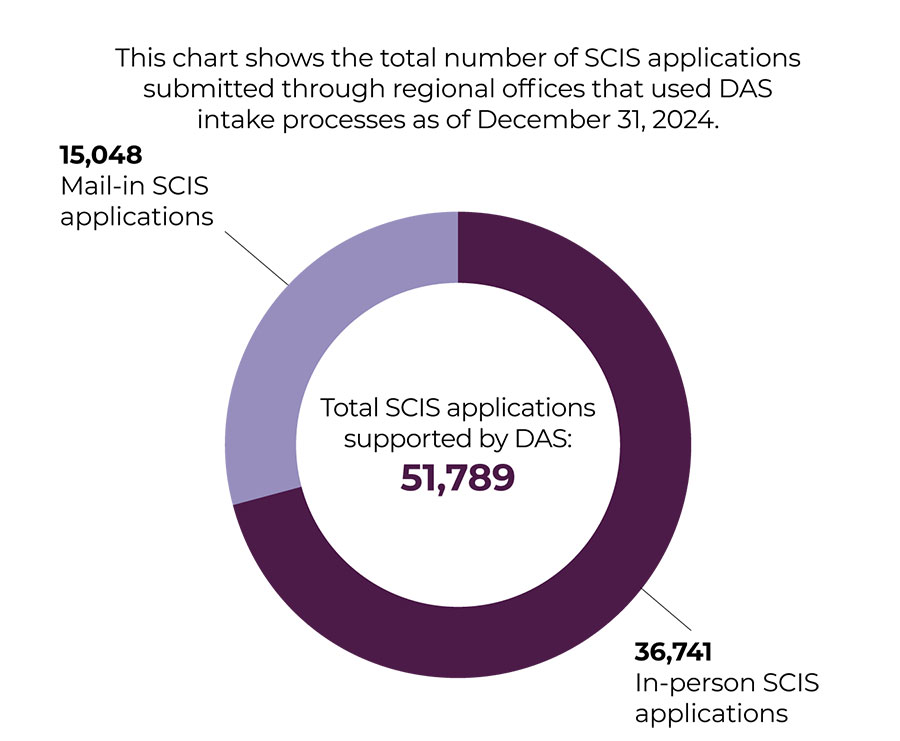
Text alternative for DAS volumes
This chart shows the total number of SCIS applications submitted through regional offices that used DAS intake processes as of December 31, 2024:
- In-person SCIS applications: 36,741
- Mail-in SCIS applications: 15,048
- Total SCIS applications supported by DAS: 51,789
SCIS auto-print
Since its gradual rollout in June 2024, DAS has enhanced an auto-print feature that allows status card applications that meet specific criteria to skip the processing queue and be automatically sent for card printing.
By sending straightforward and low-risk status card applications directly to print, staff can spend more time on challenging applications or serve more individuals, improving overall service delivery.
This new feature has enabled eligible applicants to receive their status card in as little as two weeks.
In 2024, a total of 3,338 applications were auto-printed, representing approximately 6.4% of total DAS applications. As DAS continues to process a higher volume of applications in years to come, the auto-print feature is expected to have an increasingly positive long-term impact.
Secure Certificate of Indian Status Photo App
In 2019, ISC launched a cost-free, easy to use SCIS Photo App to enable applicants to submit a photo for their SCIS application with their smartphone. The app provides easy, step-by-step instructions to guide applicants through the photo capture process and securely encrypts the photos to protect their privacy. The app eliminates the cost of getting professional passport-style photos and makes the application process more accessible and convenient to individuals and First Nations communities across the country.
In 2024, 54,792 photos were taken using the SCIS Photo App, saving applicants approximately $822,000, based on the average cost of a passport photo available through a retailerFootnote 24.
Online Booking Tool (WaitWell)
In 2024, the Online Booking Tool (WaitWell) was introduced at ISC service kiosks in Edmonton, the National Capital Region, and Amherst to modernize the way applicants book in-person appointments at regional offices for registration and status card services.
Applicants can access WaitWell on the Department's website, allowing them to book appointments directly from their devices without needing to call the regional office.
It also generates various messages such as, appointment reminders, instructions and examples of what documents to bring. These messages result in more complete application submissions as people come prepared for their appointment and allow for easier communication to reduce appointment no-shows. WaitWell also allows regional offices to create virtual line-ups for outreach events, enabling applicants to join directly from their devices.

Text alternative for Online Booking Tool (WaitWell)
Total WaitWell appointments in 2024: 10,215
- 2,353 appointments booked by applicants
- 7,862 appointments managed by regional offices
Operational improvements
Discretionary decisions by the Registrar
The Registrar is responsible for maintaining the accuracy and integrity of the Indian Register and making decisions related to entitlement to registration under the Indian Act.
To improve efficiency and service delivery, the Registrar uses Devolved Administrative Authority, which allows designated officers to make decisions on behalf of the Registrar, including:
- processing applications for registration;
- updating registration records; and
- completing First Nation transfers.
Before receiving delegation authority, officers undergo extensive training to ensure they understand the Indian Act and related policies and procedures to make fair and consistent decisions. The delegation of authority helps foster a more responsive, accessible, and efficient registration system for First Nations individuals and communities, which reduces wait times for individuals and communities.
Delegated entitlement officers are able to render most registration decisions as administrative decisions. However, in some situations where an applicant is unable to meet the documentation requirements outlined in the policy, where there is minimal or conflicting evidence or when the applicant is protesting a decision, the Registrar will conduct a review of the file and make a discretionary decision.
In 2023, the Registrar made a total of 77 discretionary decisions. While in 2024, the Registrar launched a new streamlined process to make discretionary decisions more quickly and accurately, resulting in a total of 285 discretionary decisionsFootnote 25.
End-to-end processing for Registration and Secure Certificate of Indian Status Applications
End-to-end processing is an internal system improvement that automates SCIS issuance for some applicants who applied for registration and their SCIS at the same time. In 2024, end-to-end processing enhanced operational efficiency for over 13,297 applications.
National training for regional staff
Starting in April 2024, regional staff were retrained on registration based on a new and enhanced curriculum.
This initiative supported the implementation of a nation-wide service benchmark, ensuring that applicants across Canada receive the same level of expertise across all regional offices. Additionally, it helped strengthen the integrity of the Indian Register by standardizing procedures and reducing inconsistencies, resulting in a more reliable and unified registration system across Canada.
-
110 ISC employees certified through the new curriculum
- 95 employees providing in-person services
- 15 employees at headquarters supporting regional offices
Communications
In 2024, we continued our work to reach entitled First Nations individuals, non-registered First Nations individuals, First Nations leadership, and service providers, further enhancing the overall awareness and understanding of registration, membership, and status cards.
Web communications
In 2024, our work focused on making the content clearer for applicants. In response to feedback we have gathered from a number of sources, the webpages were updated to more clearly explain registration entitlement under the Indian Act.
Additional updates included:
- Clearer language outlining the service standard for registration, including expected processing times and potential delays
- Updated visuals to help individuals determine their entitlement to registration under the Indian Act
This work supports a broader commitment to clear, accessible information and improved trust in registration services.
Website traffic to registration-related content

Text alternative for Website traffic to registration-related content
The month over month web traffic has remained stable with 1,228,471 visits to the website in 2024, and a total of 2,742,847 page views.
Social media

Text alternative for Social media
In 2024, ISC published 125 posts through ISC social media channels, 56 on information related to registration and 69 on status cardsFootnote 26.
Review by the Office of the Auditor General
In May 2024, the Office of the Auditor General began a performance audit of the registration process under the Indian Act between April 1, 2019 and March 31, 2024.
A performance audit is an independent, objective, and systematic assessment of how well the government is managing its activities, responsibilities, and resources. Performance audits do not question the merits of government policies. Rather, they examine the government's management practices, controls, and reporting systems based on its own public administration policies and on best practices.
The audit was launched in response to the June 2022 report titled, Make It Stop! Ending the Remaining Discrimination in Indian Registration, in which the Standing Senate Committee on Indigenous Peoples recommended that the Office of the Auditor General of Canada conduct a performance audit of ISC's registration process under the Indian Act. The goal of the audit was to determine whether ISC and Crown-Indigenous Relations and Northern Affairs Canada effectively and efficiently managed the registration process, with a focus on the implementation of legislative amendments to the Act's registration provisions since 1985.
ISC welcomes this audit and the opportunity to push forward significant reforms to both the legislation governing registration and membership, as well as the process that supports it, which is captured in the Government Response to the Senate Report.
Due to the difference in timeframe assessed by the Auditor compared to the annual scope of this report, there may be some variances in data. The department will directly address the findings and recommendations of the audit in the 2025 Annual Report.
Looking forward to 2025
ISC acknowledges that understanding registration under the Indian Act, shaped by decades of legislative change, remains complex. Myths, misconceptions, and outdated beliefs stemming from Canada's colonial history represent significant barriers to Indigenous people accessing the rights and benefits associated with registration under the Indian Act.
Simplifying the application process while making sure accurate and comprehensive information is shared with individuals, First Nations leaders, and communities continues to be a top priority. Many people continue to face difficulties establishing the familial and community connections required to demonstrate entitlement to registration. In response, ISC is committed to continuing ongoing efforts to improve service delivery, and advance legislative reform, in close collaboration with Indigenous Rights-Holders.
This Report intends to provide transparency and accountability to Indigenous rights-holders and Canadians on the Department's commitments to registration, membership and status cards. As ISC looks ahead, we will continue to improve accessibility, timeliness, and trustworthiness in the registration process.
Annex A: Financial and human resource statements
| Region | Vote 1 | Total Vote 1 costs | Vote 10 | Total Vote 10 costs | Total costs | ||
|---|---|---|---|---|---|---|---|
| Salary | Operations & Maintenance | Contributions | Grants | ||||
| Regions | $5,104,191 | $244,310 | $5,348,501 | $8,902,196 | $2,636,782 | $11,538,978 | $16,887,479 |
| Headquarters | $25,423,814 | $4,721,349 | $30,145,163 | $150,000 | - | $150,000 | $30,295,163 |
| Total | $30,528,005 | $4,965,659 | $35,493,664 | $9,052,196 | $2,626,782 | $11,688,978 | $47,182,642 |
Federal Budget: Through Budget 2024, the government allocated $53 million, over five years, starting in 2024-25, and $10.6 million ongoing, to allow ISC to deliver registration services under the Indian Act.
Vote 1 salary: This is funding used to hire ISC staff. This includes processing staff, service staff and other services staff. Other services staff is comprised of communications and policy, registration support, card issuance and related services.
Vote 1 Operations & Maintenance: This is funding used by the program to manage the day-to-day activities required to maintain the cost of doing business. This includes material costs such as envelopes and postage, printing of status cards, costs associated with purchasing devices, office supplies and other services.
Vote 10 contributions: This is transfer payment funding provided to First Nations for the delivery of programs and services, that is subject to performance conditions specified within the contribution funding agreement. A contribution is to be accounted for and is subject to audit. For Registration and Membership, this is funding provided to First Nations for Contributions to Indian Bands for Registration Administration.
Vote 10 grants: This is New Fiscal Relationship (NFR) transfer payment funding that is subject to pre-established eligibility and other entitlement criteria that is provided to First Nations to be used for the delivery of programs or services. This funding is not subject to being accounted for by a recipient nor normally subject to audit by the department. The recipient may be required to report on results achieved. Funding provided to First Nations for Registration Administration is one of the eligible programs for the New Fiscal Relationship Grant. There were 160 First Nations that were part of the New Fiscal Relationship as of December 31, 2024.